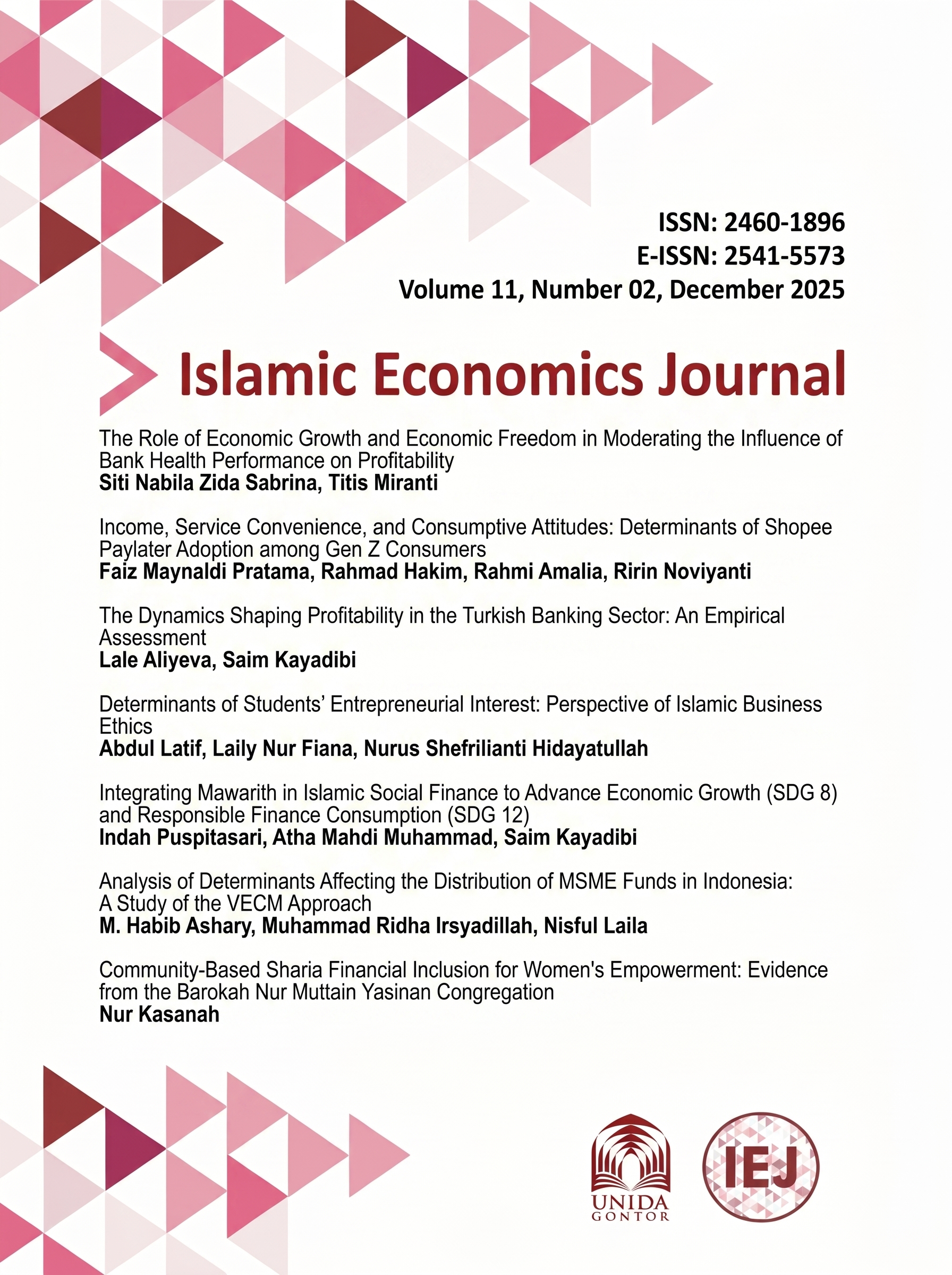
Community-Based Sharia Financial Inclusion for Women’s Empowerment: Evidence from the Barokah Nur Muttain Yasinan Congregation
DOI:
https://doi.org/10.21111/iej.v11i02.58Keywords:
Sharia Financial Inclusion, Yasinan Congregation, Sharia Cooperatives, Empowerment, WomenAbstract
Financial inclusion is a condition in which everyone has fair and equitable access to a wide range of financial products and services, including sharia-compliant ones. The use of Islamic finance has not been optimal in empowering rural women because there is still limited access to inclusive Islamic financial institutions. This study aims to analyze the role of Islamic financial inclusion in increasing women’s economic empowerment through community-based financial practices. This qualitative, phenomenological research explores the role of Islamic financial inclusion in advancing women’s economic empowerment through community-based financial
practices. The locus of this research is KSPPS Barokah Nur Muttain, Tebon Village, West District, Magetan Regency, serving as a model of sharia financial inclusion for the Yasinan Barokah Nur Muttain pilgrim community. Data were obtained through participatory observations and in-depth interviews with cooperative administrators, Yasinan Barokah Nur Muttain congregational mothers, community leaders, and related officials at the Cooperatives and MSEs Office, as well as documentation on the performance of KSPPS Barokah Nur Muttain. The study results show that implementing sharia financial inclusion within the Yasinan congregation community at KSPPS Barokah Nur Muttain effectively supports women’s empowerment by integrating access to sharia financing and spiritual activities. The supporting factors include religious values, solidarity, and trust among members, while the main challenges are limited capital and low financial literacy. This Islamic financial inclusion empowers 45 women, as seen in improved family finances, the development of small businesses, and strengthened social networks through Yasinan activities. This research is expected to create an effective Islamic financial inclusion model for women’s empowerment at the local level.
Downloads
Submitted
Published
Issue
Section
License
Copyright (c) 2025 Islamic Economics Journal

This work is licensed under a Creative Commons Attribution-ShareAlike 4.0 International License.