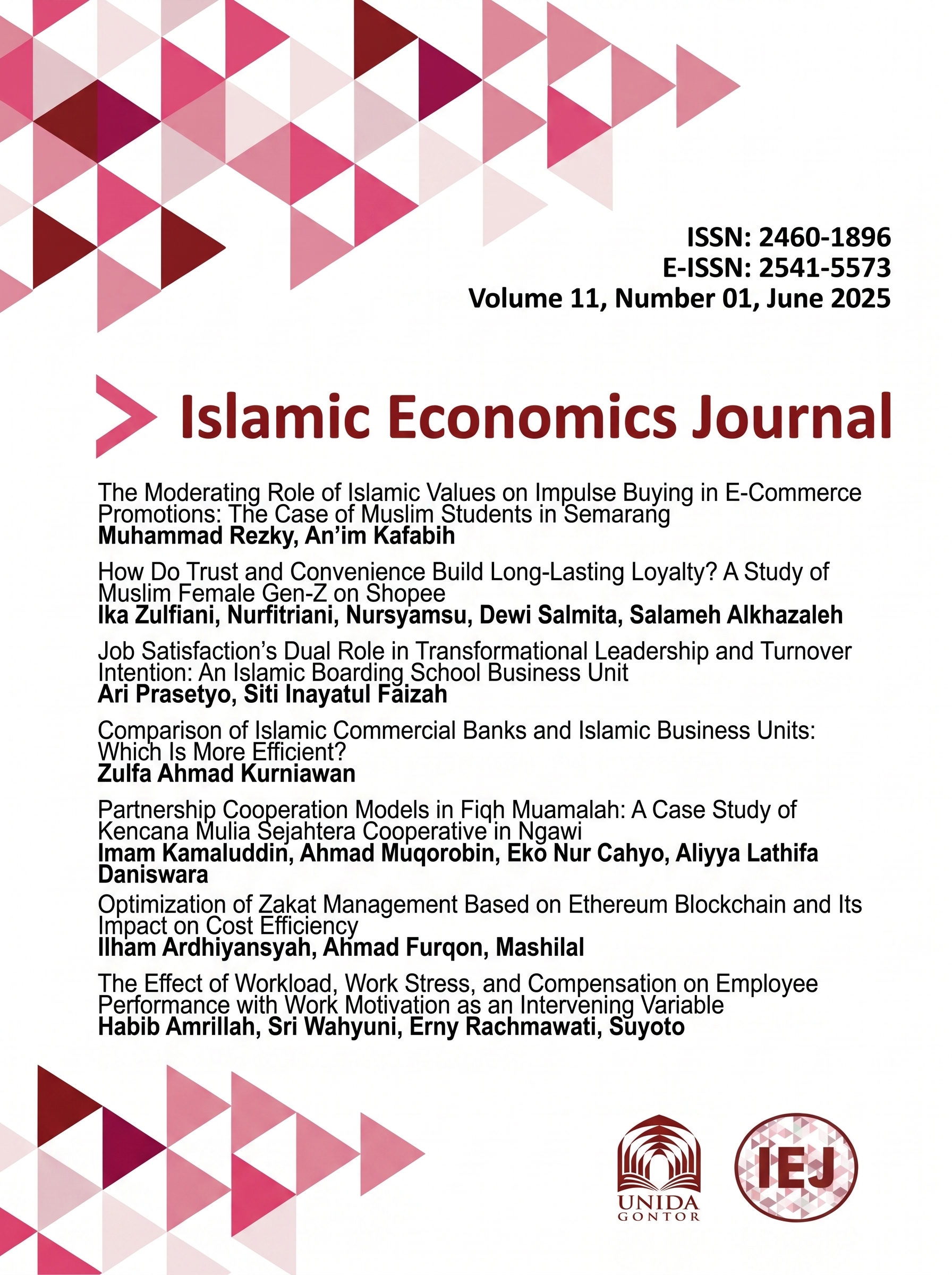
The Effect of Workload, Work Stress, and Compensation on Employee Performance with Work Motivation As an Intervening Variable
DOI:
https://doi.org/10.21111/iej.v11i01.15Keywords:
Workload, Stress Work, Compensation, Motivation Work, Employee PerformanceAbstract
This study aims to investigate the impact of work burden, work stress, and compensation on employee performance,
with motivation serving as an intervening variable. This research employs a quantitative approach, using a
method that collects data in the form of questionnaires, which are then converted into a Likert scale. In research,
populations and samples are often discussed. There are 100 employees at LAZISMU Central Java, and the study
employs saturated sampling, a type of non-probability sampling. Analysis method used in this study: SEM
PLS (Structural Equation Modeling - Partial Least Squares). The study’s results indicate that workload has a
significant effect on work motivation and employee performance, both directly and through work motivation as
an intervening variable. The more precise the workload management, the higher the motivation and performance
produced. In contrast, compensation and work stress have no significant effect, either directly or indirectly,
on motivation and performance. These findings indicate that in a work environment like Lazismu Banyumas,
employee performance is more influenced by internal factors and work values, such as the meaning of workload
and motivational strength, rather than financial incentives or work pressure.
Downloads
Submitted
Published
Issue
Section
License
Copyright (c) 2025 Islamic Economics Journal

This work is licensed under a Creative Commons Attribution-ShareAlike 4.0 International License.