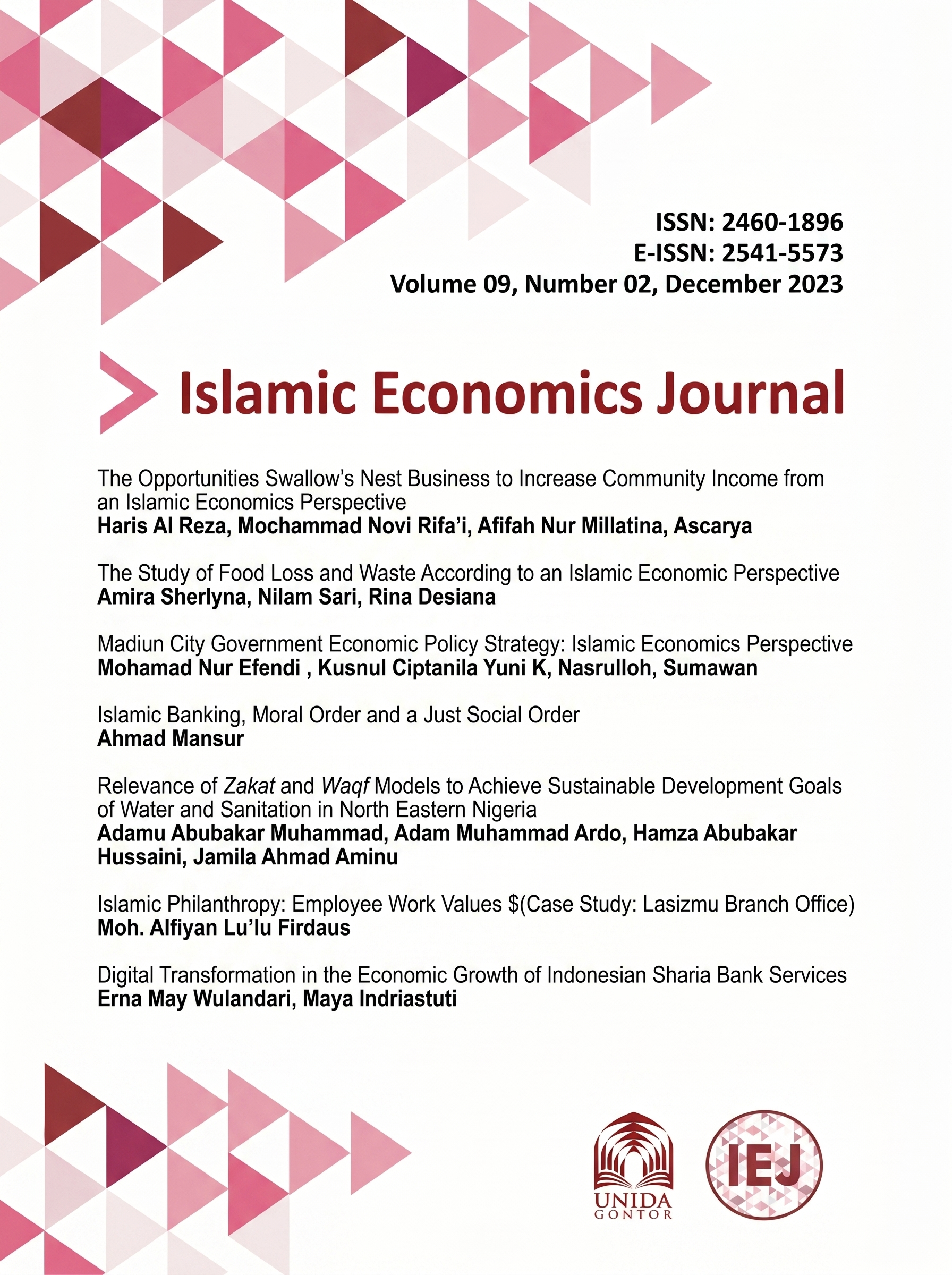
The Study of Food Loss and Waste According to an Islamic Economic Perspective
DOI:
https://doi.org/10.21111/iej.v9i02.35Keywords:
Food Loss, Food Waste, ConsumptionAbstract
The occurrence of food loss and waste is closely related to less effective and efficient consumer behavior that causes a lot of food wasted and excessive food waste accumulation. Consumer behavior according to Islam encompasses a series of ethics and principles of consumption: simplicity, balance, hygiene, generosity, and responsibility. The study aims to understand the impact of simplicity, balance, hygiene, generosity, and responsibility on control of food loss and waste. This research uses quantitative methods with nonprobability sampling techniques as a sampler technique. The sample in this study is 100 communities that reside in Banda Aceh City. The data analysis technique in this study is a double linear regression analysis by spreading the questionnaire. The results showed that the variables of simplicity and generosity partially influenced the control of food loss and waste. The variables balance, hygiene and partial responsibility do not affect the control of food loss and waste. Variables of simplicity, balance, hygiene, generosity, and responsibility simultaneously have a positive and significant impact on the control of food loss and waste. In this way, people are expected to change consumer habits that can damage the environment. Governments and related agencies can deal with food loss and waste by educating the public and improving infrastructure to support efficient food production processes as well as developing regulations related to food losses and waste.
Downloads
Submitted
Published
Issue
Section
License
Copyright (c) 2023 Islamic Economics Journal

This work is licensed under a Creative Commons Attribution-ShareAlike 4.0 International License.