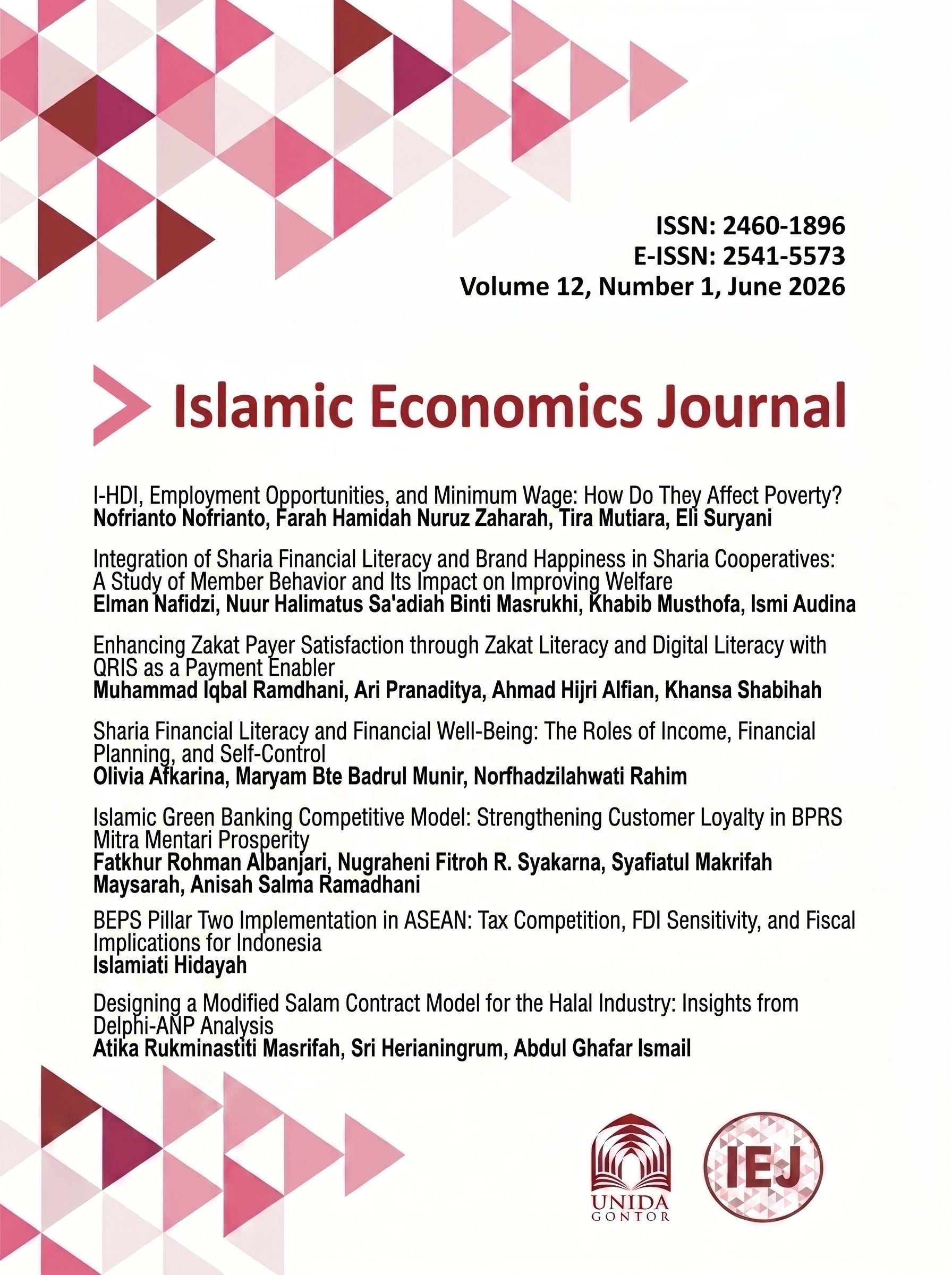
I-HDI, Employment Opportunities, and Minimum Wage: How Do They Affect Poverty?
DOI:
https://doi.org/10.21111/iej.v12i01.3Keywords:
Poverty, Unemployment, Islamic Human Development Index (I-HDI), Employment Opportunity, Minimum WageAbstract
Java Island remains the largest centre of poverty in Indonesia despite its dominant contribution to national economic activity. This study examines the direct effects of the Islamic Human Development Index (I-HDI), employment opportunities, and minimum wage on poverty, as well as their indirect effects through unemployment, in six provinces of Java Island during 2015–2022. This study uses secondary panel data obtained from official statistical sources and applies panel data regression with path analysis using EViews 10. The findings show that employment opportunities have a negative and significant effect on unemployment, while I-HDI and minimum wage have negative and significant direct effects on poverty. However, unemployment does not significantly mediate the effects of I-HDI, employment opportunities, and minimum wage on poverty. These findings imply that poverty reduction in Java Island should not rely solely on unemployment reduction, but should also prioritise Islamic-based human development, the expansion of decent employment opportunities, and minimum wage policies that improve household welfare without weakening labour absorption.
Downloads
Submitted
Accepted
Published
Issue
Section
License
Copyright (c) 2026 Islamic Economics Journal

This work is licensed under a Creative Commons Attribution-ShareAlike 4.0 International License.