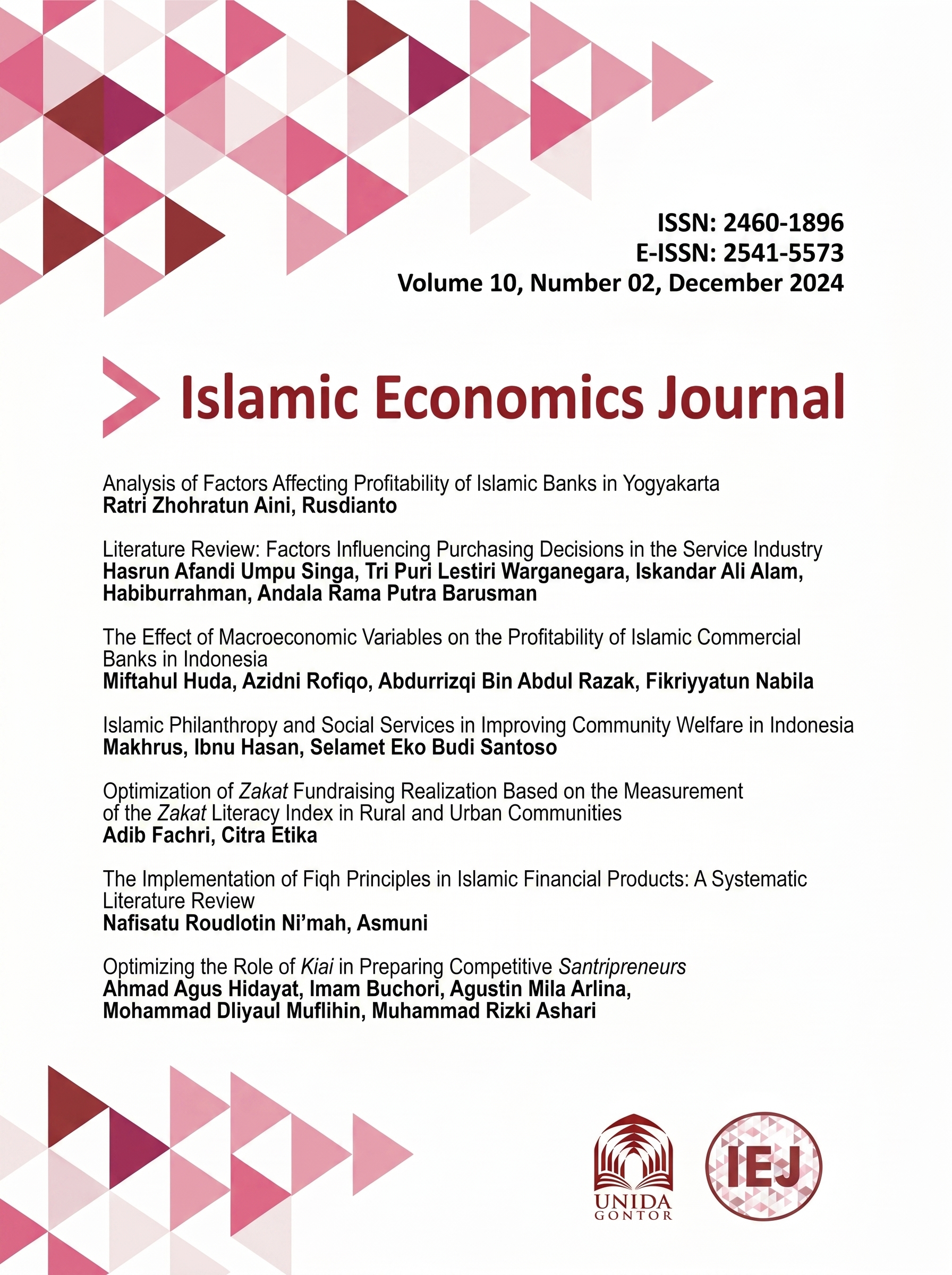
The Effect of Macroeconomic Variables on the Profitability of Islamic Commercial Banks in Indonesia
DOI:
https://doi.org/10.21111/iej.v10i02.29Keywords:
Profitability, Macroeconomic Variable, Vector Error Correction ModelAbstract
Islamic banks as a form of banking that operates based on sharia principles, are expected to show superior financial
performance when compared to interest-based conventional banks. This study aims to determine the effect of
inflation, JUB, and PUAS on the profitability of Indonesian Islamic Commercial Banks. The method used in
this research is a deductive quantitative method, with the Vector Autoregressive (VAR) Vector Error Correction
Model (VECM) approach and the E-Views 12 test tool. The data used in this study used secondary data with
time series data from the period January 2013 to April 2023, where ROA was used as an independent variable
and Inflation, Money Supply, and Islamic Interbank Money Market became the dependent variable. As for the
results of this study, in the long term, the variables of Inflation and JUB have a significant and negative effect
on the Return on Assets (ROA) of Indonesian Islamic Commercial Banks, while the Islamic Interbank Money
Market (PUAS) variable does not have a significant and negative effect on the Return on Assets (ROA) of
Indonesian Islamic Commercial Banks. In the short term, the variables of Inflation, Money Supply (JUB), and
the Islamic Interbank Money Market (PUAS) do not have a significant and negative influence on the Return
on Assets (ROA) of Indonesian Islamic Commercial Banks.
Downloads
Submitted
Published
Issue
Section
License
Copyright (c) 2024 Islamic Economics Journal

This work is licensed under a Creative Commons Attribution-ShareAlike 4.0 International License.