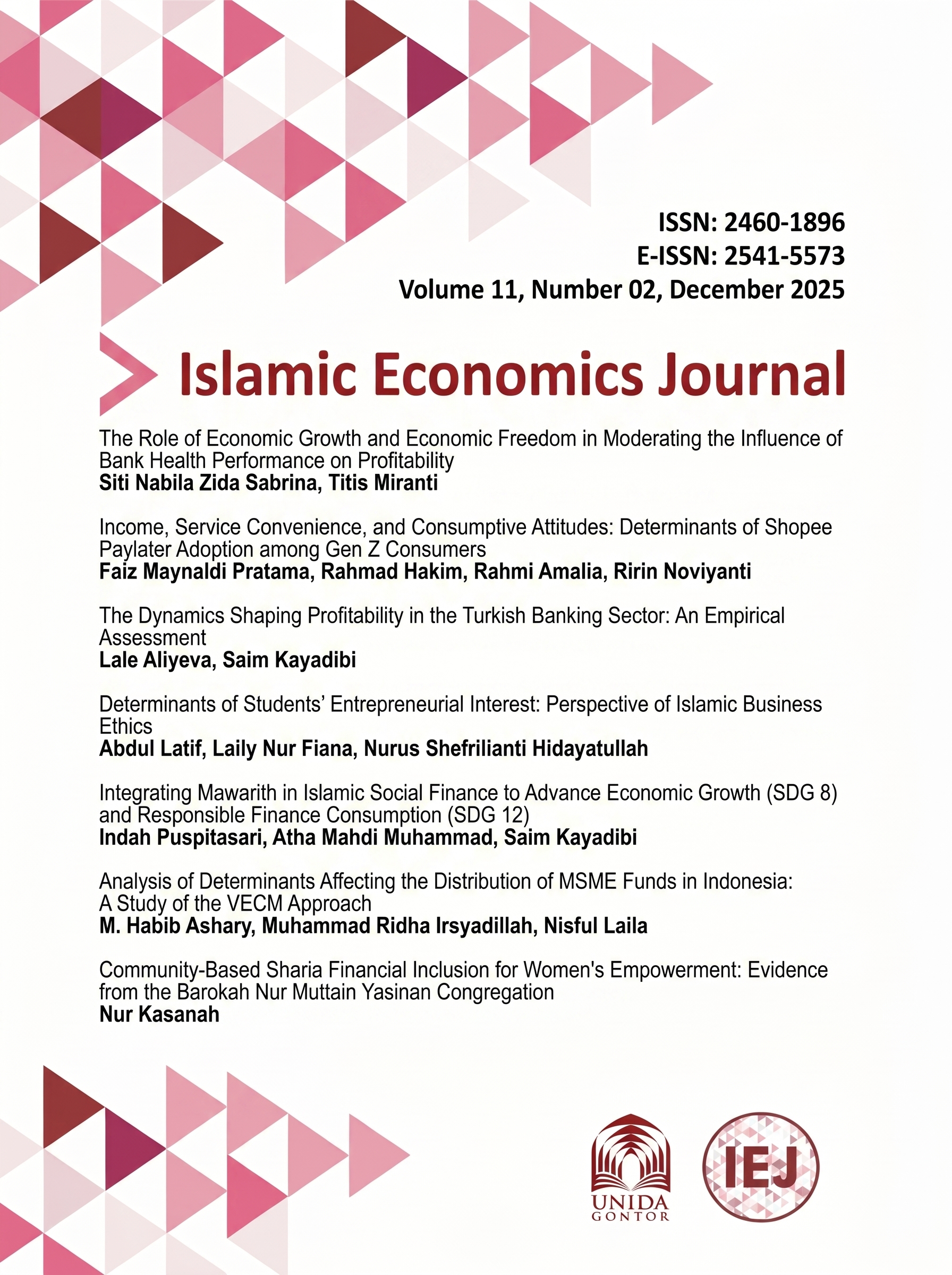
Determinants of Students’ Entrepreneurial Interest Perspective of Islamic Business Ethics
DOI:
https://doi.org/10.21111/iej.v11i02.23Keywords:
Entrepreneurial Literacy, Motivation, Income Expectation, Islamic Business Ethics, Entrepreneurial InterestAbstract
Indonesia is a developing country with abundant natural resources and a large population, it still faces significant
unemployment. Unemployment among college graduates is a major challenge, even though they have the
potential to become entrepreneurs who can help reduce it. Entrepreneurship plays an important role in driving
economic growth and creating job opportunities, especially for college students who are the next generation of
the nation. Therefore, higher education institutions need to direct graduates not only to focus on becoming labor
absorbers but also to create their own jobs. The purpose of this study is to identify the factors influencing female
students’ interest in entrepreneurship from the perspective of Islamic business ethics among female students of
the Faculty of Economics and Management at the University of Darussalam Gontor in 2024, with a focus on
entrepreneurial literacy, motivation, and income expectations. To process the data, the authors used SmartPLS
4.0.9.9. The results of this study were obtained from the respondents’ answers; entrepreneurial literacy and
motivation have a positive and significant effect on entrepreneurial interest. And income expectations do not
have a positive and significant effect on entrepreneurial interest. The data show that entrepreneurial literacy,
motivation, and income expectations have a positive and significant effect on entrepreneurial interest. This study
found that the entrepreneurial interest of Darussalam Gontor University students is influenced by entrepreneurial
literacy, motivation, and income expectations in 72.1%, and the remaining 27.9% is influenced by other factors.
Downloads
Submitted
Published
Issue
Section
License
Copyright (c) 2025 Islamic Economics Journal

This work is licensed under a Creative Commons Attribution-ShareAlike 4.0 International License.